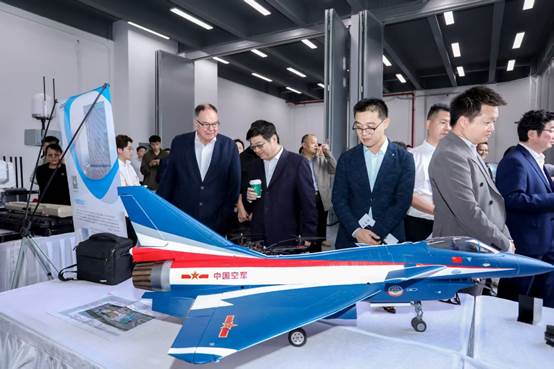
On the afternoon of October 28, the launch ceremony for low-altitude operations at the Shenzhen Integrated Land-Air Intelligent Connected Transportation Testing Base was grandly held at the Bay Area Intelligent Connected Test Field in Pingshan District. This marked the official operation of the country’s first pioneering integrated land-air testing base. Yuan Huyong, Member of the Standing Committee of the Pingshan District Committee and Executive Deputy District Mayor; Wang Huinong, First Secretary of the Party Committee of Shenzhen’s New Energy and Intelligent Connected Vehicle Industrial Chain; officials from the Municipal Office of Civil-Military Integration, the Municipal Development and Reform Commission, the Municipal Transportation Bureau, the Municipal Emergency Management Bureau, the Municipal Fire and Rescue Corps, the Municipal New Energy Vehicle Industry Office, and other relevant departments; as well as Zhang Jin, Deputy Chief Engineer of the Operation Management Department of China Automotive Technology and Research Center Co., Ltd., jointly inaugurated the base.
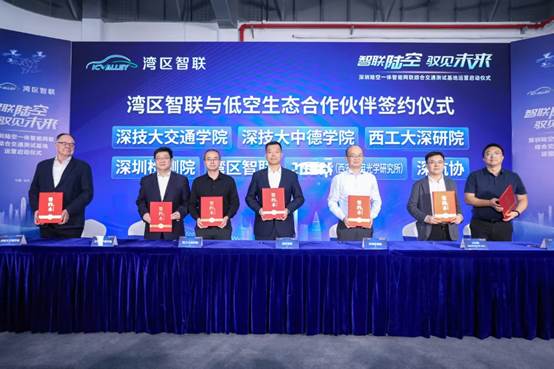
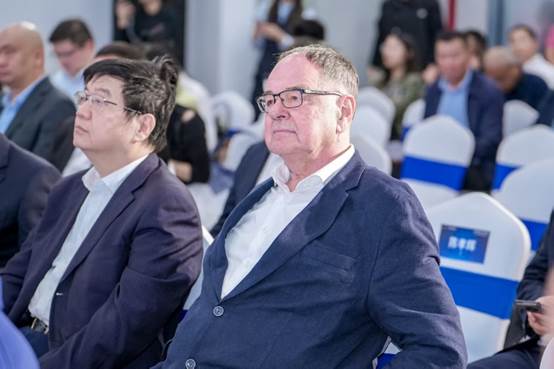
Professor Franz Raps, Dean of College of Urban Transportation and Logistics, attended the ceremony as a guest. On behalf of the College, he signed the Bay Area Intelligent Connectivity and Low-Altitude Ecosystem Cooperation Agreement during the signing ceremony. The signatories included top-tier universities, research institutions and industry organizations such as the College of Urban Transportation and Logistics at Shenzhen Technology University, the Sino-German Institute of Intelligent Manufacturing at Shenzhen Technology University, the Shenzhen Research Institute of Northwestern Polytechnical University, Shenzhen Institute of Metrology and Quality Inspection, Bay Area Intelligent Connectivity Co., Ltd., and the Shenzhen General Aviation Association. The College will work with Bay Area Intelligent Connectivity and other low-altitude ecosystem partners to build a collaborative and innovative industrial ecosystem.
Additionally, Dean Franz, together with Northwestern Polytechnical University, unveiled the Undergraduate Low-Altitude Training Center on behalf of the College. The center will focus on cutting-edge fields including unmanned aerial vehicles (UAVs), unmanned ground vehicles (UGVs), and low-altitude logistics. It will advance the integrated development of industry, academia, research and application, build an open and collaborative platform for undergraduate internships, practical training and scientific research innovation oriented toward the future, and establish a collaborative network linking education, scientific research and industrial application.
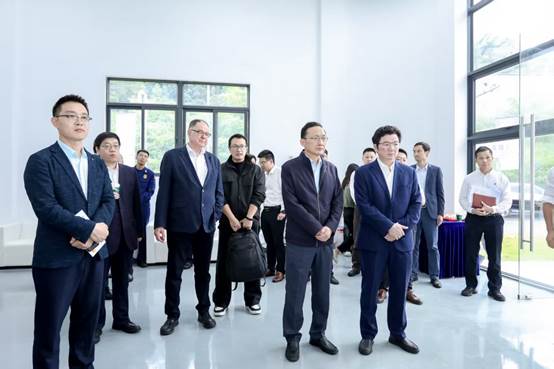
Shenzhen is currently seizing opportunities for the development of the low-altitude economy, promoting the integrated development of intelligent connected vehicles and low-altitude aircraft, and accelerating the construction of a future integrated land-air transportation system. The newly operational testing base is a key initiative to implement the Shenzhen High-Quality Construction Plan for Low-Altitude Infrastructure (2024–2026) and an important upgrade to the functional layout of low-altitude testing sites across the city. Pingshan District will continue to improve the functions of the integrated land-air testing base, striving to achieve the goals of "the best in the Bay Area, leading domestically and world-class internationally".
The Bay Area Intelligent Connected Test Field is currently the only municipal government-funded professional intelligent connected testing site in the Guangdong-Hong Kong-Macao Greater Bay Area and a core component of the Shenzhen Intelligent Connected Transportation Testing Demonstration Platform. Covering an area of 645 mu (0.43 square kilometers) with a total investment of approximately 800 million yuan, it officially opened to the public in June 2024 and is widely recognized in the industry for its "cutting-edge design, concentrated scenarios, comprehensive functions and industry-wide recognition".
The official operation of the testing base will significantly elevate Pingshan’s status in the low-altitude economy landscape of Shenzhen and the Greater Bay Area. It will serve as a powerful engine for Pingshan to build an "Integrated Land-Air Smart Vehicle Valley" and for Shenzhen to develop into a globally leading low-altitude economy hub.